
In our issue of March 14th we reviewed Mr. Archibald Dobbs’ pamphlet on ‘Real Representation for Ireland,’ in which Mr. Dobbs detailed a scheme of proportional representation, which had our hearty approval. The principle of proportional representation must appeal to every one who believes in real freedom. Finland is the only country in Europe at the present time in which the various sections of the population are represented in proportion to their numbers. In France, Germany, Switzerland, and some other countries devices such as the second ballot, the referendum; and so forth are used to permit the minority some representation. In England, however, and in Ireland as legislated for by England, the most anomalous system of representation in the civilised world exists. Our Unionist fellow-countrymen sometimes allege or complain that they are not represented in their fair proportion. Gentlemen, it is the English Parliament you support which has made the laws which prevent you from securing proportional representation. We have no hand in them.
Amongst the cant phrases of British Liberalism is ‘One vote one value.’ It is utterly impossible under the existing electoral system in England, and imposed by England upon this country, for one vote to have one value. At the last General Election in England 2,377,000 Liberal voters returned 342 representatives, whilst 2,194,000 Tory voters only secured 141 members. Thus the Liberal voters’ vote was worth two-and-a-half Tory votes. This is not representation and can never be. It may be truly said that the British House of Commons is the most unrepresentative political assembly in Europe. Of what value to Liberalism is the vote of a British Liberal in the City of London, of a British Tory to Toryism in three-fourths of Wales, of an Irish Unionist to Unionism in Kerry or Clare, or an Irish Nationalist to Nationalism in South Dublin? It is of no value and no worth. The small minority voter is a cypher of absolutely no political value under the present system.
Under Mr. Dobbs’ system, however, one vote one value becomes a reality by a very simple process. Instead of voting in 100 constituencies, Ireland would vote in seven. Eventually, Ireland should vote in one, just as in our municipalities the absurd and corrupting ward system should be swept out of existence, and our Corporations elected by the whole body of the electors. The seven divisions of Ireland proposed by Mr. Dobbs are shown on the map printed above: They are:—
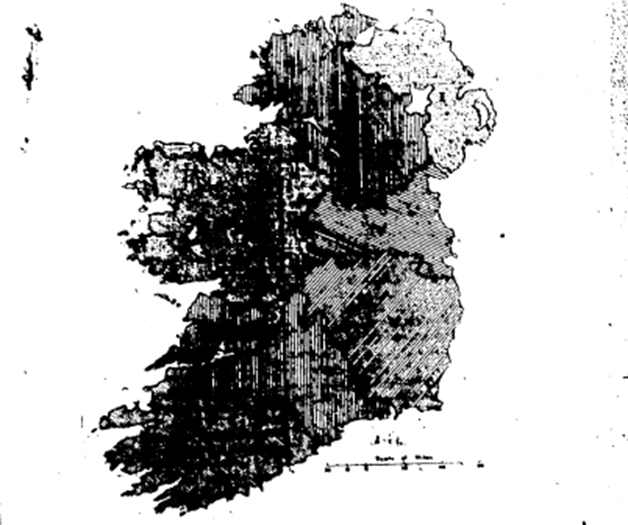
- Ulster East, containing County Antrim (the present four constituencies), Belfast City (4), Londonderry Co. (2), Londonderry City (1), County Down (4), and Newry (1). 16 constituencies seating 17 members.
- Ulster West—County Armagh (3), County Cavan (2), County Donegal (4), County Fermanagh (2), County Monaghan (2), County Tyrone (4). 17 constituencies seating 17 members.
- Connacht—County Galway and Connemara (4), Galway City (1), Co. Leitrim (2), County Mayo (4), County Roscommon (2), County Sligo (2). 15 constituencies seating 15 members.
- Leinster North—County Louth (2), County Longford (2), Co. Meath (2), County Westmeath (2), County Dublin (2), Dublin City (4). 14 constituencies seating 14 members.
- Leinster South—County Kildare (2), King’s County, Birr, and Tullamore (2), Queen’s County, Leix, and Ossory (2), County Carlow (1), County Wicklow (2), County Kilkenny (2), Kilkenny City (1), Co. Wexford (2). 14 constituencies seating 14 members.
- Munster North-East—County Clare (2), County Tipperary (4), County Limerick (2), Limerick City (1), County Waterford (2), Waterford City (1). 13 constituencies seating 13 members.
- Munster South-West—County Kerry (2), County Cork (7), Cork City (1 with 2 members). 12 constituencies seating 13 members.
We have already explained the proportional representation scheme. We shall (?).1 Taking No. 1 Division as an example—Ulster East—the elector on going to the poll, instead of voting as at present for one candidate, would vote for 17 or any lesser number he desired. The total number of electors in the constituency is 140,000. Let us assume the total number who went to the poll to be 110,000. Seventeen—the number of seats to be filled—divided into 110,000 is in round figures 6,500. The candidate who receives 6,500 votes or more, therefore possesses the confidence of one-seventeenth of the electorate, and is entitled to take his seat. No combination can prevent a minority, even though it be only 1 in 17, from securing representation under this system. Under the present system it is impossible for it to secure representation of any kind. There are, for instance, considerably more than 6,500 Sinn Féin voters scattered through these 16 constituencies. But in no one constituency do they possess a majority, therefore they can secure no representation. But if the constituencies were grouped as under this scheme, by no possibility could they be prevented from electing one representative to every 6,500 of their votes. Though they numbered less than a thousand in each constituency, their power would be real and effective.
Again take No. VI.—Munster North-East. At the present time a Unionist cannot secure election in any of these constituencies, although the voting power of Unionism entitles it here to one representative. Taking the divisions as they stand we calculate that if a General Election in Ireland were fought within the present year, on the proportional representation system, the result would be:—
| Division | Unionist | Parliamentarian | Sinn Féin |
| I. | 11 | 4 | 2 |
| II. | 5 | 10 | 2 |
| III. | 1 | 9 | 5 |
| IV. | 3 | 3 | 8 |
| V. | 1 | 6 | 7 |
| VI. | 2 | 6 | 4 |
| VII. | 1 | 5 | 6 |
| 24 | 42 | 34 |
Under the Irish Parliament we shall have proportional representation. The voice of the minority must not be stifled or its power fettered because it happens to be scattered over a wide area instead of being hedged in one particular spot. Our Unionist fellow-countrymen sometimes ask what guarantee they can have that they would be fairly represented in an Irish Parliament. We reply that Irish Sinn Féiners are ready to accept the principle of proportional representation, and approve the scheme of Mr. Dobbs. If they are still timid and distrustful of their countrymen, will they let us know what additional security their distrust requires?
1 Cartlann: Illegible in original scan.